
Kitchen & Catering Management System Suite
Central Kitchen Integrated Management System
Recipe standardisation, auto reverse-calculation, self-writing shift plans and IoT food safety — one integrated system for central kitchens, canteens and chain restaurants.
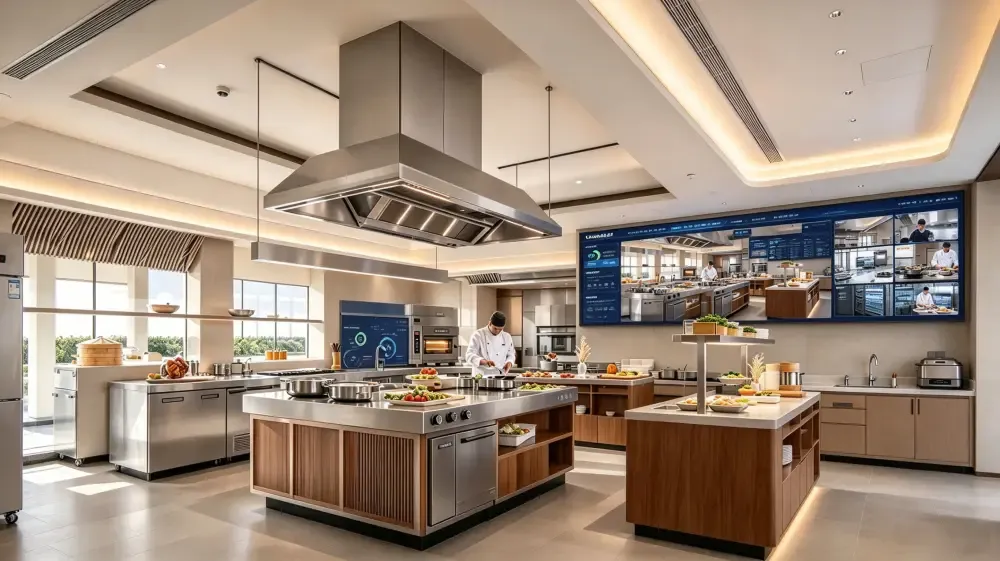
RUIYI Central Kitchen Integrated Management System brings recipe standardisation, production scheduling, procurement and food safety into one system for central kitchens, group canteens and chain restaurants.
Built on four decades of central-kitchen production experience, it turns every order into directed work: ingredients are calculated automatically, shifts are planned for you, and every step — weighing, cooking, chilling, packing — is recorded against a standard.
One umbrella over the catering suite: recipe and formula management, procurement, production and food safety run inside the same system — with monitoring, inventory and delivery tracking plugged in where you need them.
What gets in the way today
Central-kitchen pain is rarely the cooking. It is everything around it: planning, standardising and proving.
Production planning lives in spreadsheets.
Ingredient needs are reverse-calculated by hand from orders — slow, error-prone, and different with every planner.
Output depends on the chef.
Recipes live in heads; steps, timings and temperatures are not enforced, so quality drifts between shifts and training a new hire takes months.
Food safety is proven after the fact.
Cold-chain temperatures, hygiene checks and retention samples live on paper — by the time an auditor asks, the evidence is incomplete.
What you get
Four mechanisms, each replacing a manual habit around the kitchen with a system-enforced one.
Capabilities
Six capability groups, each mapped to what it does in the kitchen rather than a feature name.
Capability | What it does |
Recipe & formula management | Steps, timing, equipment, allergens and nutrition per recipe; standard portions auto-calculated. |
Production scheduling | Multi-zone, multi-role scheduling generated from orders and capacity. |
Reverse calculation & requisitions | Order-driven ingredient, procurement and requisition quantities, computed automatically. |
Food safety & IoT | Cold-chain monitoring, hygiene video alerts, gas and air-quality sensors, retention-sample records. |
Inventory & cost | Order–production–inventory integration with per-dish cost analysis and stock alerts. |
Delivery & compliance | GPS routing for distribution vehicles; licence and retention records kept audit-ready. |
How it works
1. Plan: orders and forecasts turn into production demand — ingredients are reverse-calculated and requisitions raised automatically.
2. Produce: each station receives its standardised recipe with timing, temperature and equipment — steps are verified, not remembered.
3. Watch: cold-chain, environment and safety sensors report in real time; anomalies alert before they become incidents.
4. Deliver and analyse: finished goods are tracked to delivery, and per-dish cost plus waste data feed the next cycle.
Integration & deployment
One umbrella over the catering suite.
Recipes, procurement, production and food safety modules run together; monitoring and inventory plug in as needed.
IoT on equipment you already run.
Cold-chain probes, environment sensors and kitchen cameras integrate with what the kitchen already has; energy and vehicle tracking are included.
Pilot in weeks, standardise the group.
Start with one production line or one canteen — the standard then replicates across sites and central kitchens as a template, not a project.