

Industrial Management System Suite
Manufacturing Operations Management
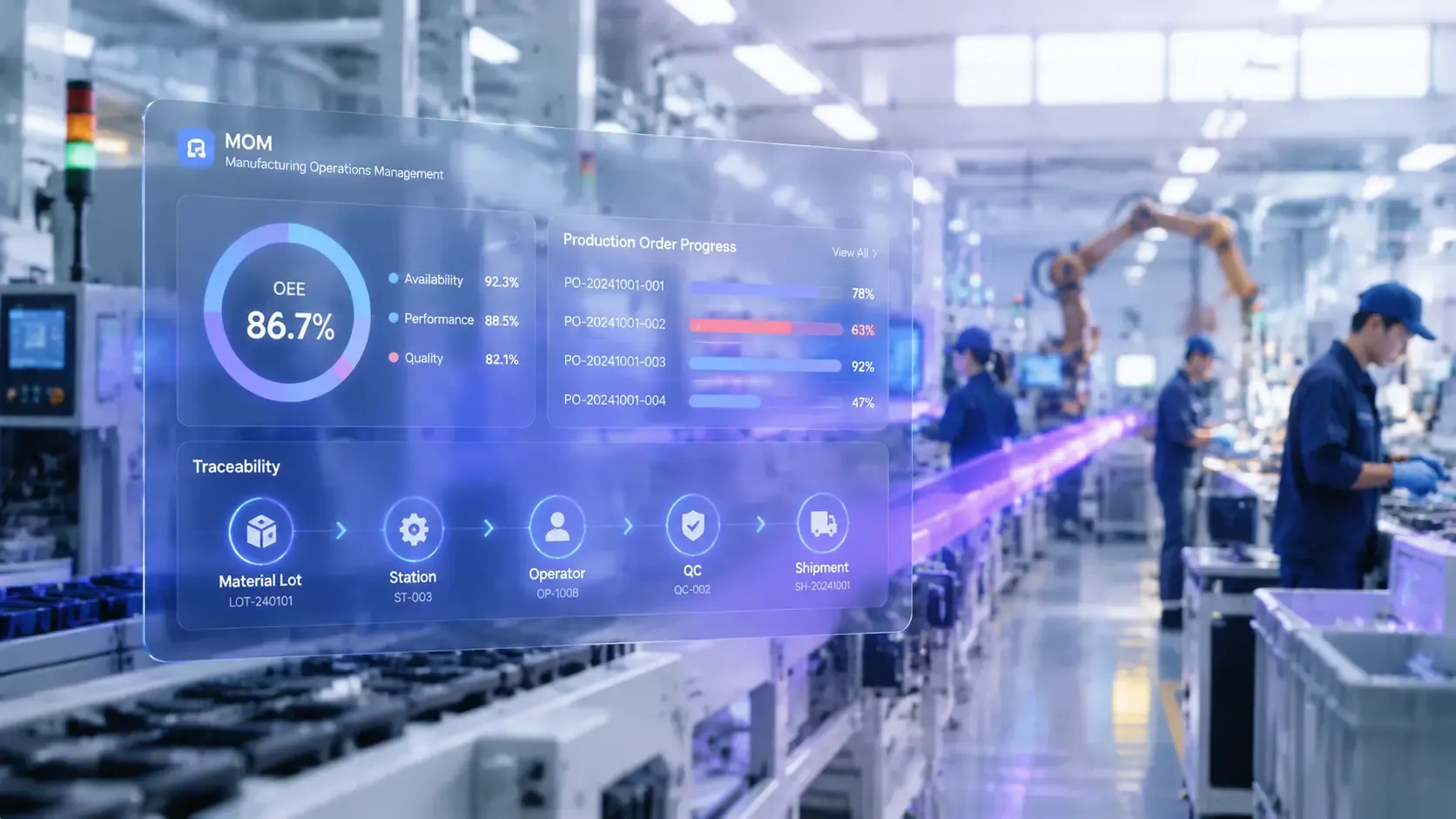
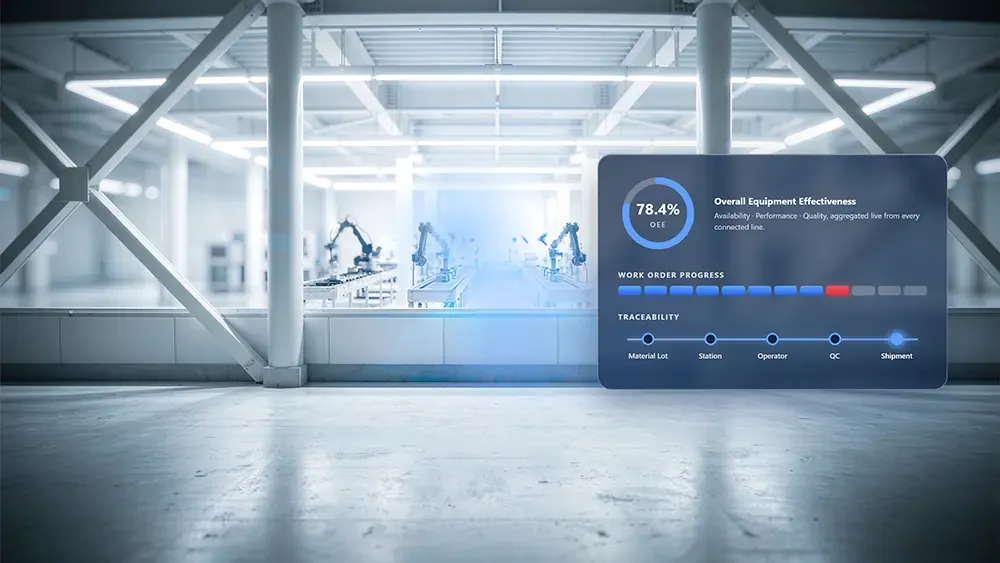
What you need is not another point solution. You need one operations layer that sees the whole picture: one goal, one plan, and data and workflows that genuinely run across departments. That is MOM — Manufacturing Operations Management.
1. What it is
In most plants, ERP decides what should be made, and machines and operators decide what actually gets made. Everything in between — how orders are scheduled, how the shop floor executes, how quality is controlled, how an incident is investigated — has long been a blind spot.
RUIYI MOM fills that gap. It sits between enterprise management (ERP) and shop-floor control (equipment, SCADA / PLC) and covers the full scope of manufacturing operations management: production operations, quality, material and WIP flow, equipment and downtime, plus the data collection and analysis that runs across all of it.
It is not another form-filling system for shop-floor reporting. It is an operations platform: once a plan is released it can be tracked, execution can be watched, quality problems can be caught in process, and every unit can be traced back to its material lot, operation, equipment, operator and process parameters.
Point | What it means |
One version of production truth | Orders, progress, WIP and inventory come from the same data set. Planning and the shop floor stop arguing about whose numbers are right. |
Traceability from material to shipment | Lot and serial-level records support forward tracking and backward tracing, so a complaint or recall is scoped in minutes rather than days. |
Exceptions answered in minutes | Material shortages, downtime and quality deviations trigger alerts and escalation automatically, with a record of who responded and how long it took. |
2. The reality on your shop floor
3. What you get
Organised around the four things overseas customers care about most — delivery, cost, quality and compliance. Each point is a business result, not a feature.
3.1 On-time Delivery
Order progress is visible in real time, so bottlenecks surface while you can still act.
Result: higher on-time delivery, fewer misses from late inserts, planners moving from firefighting to optimisation.
3.2 Lower Cost
WIP, downtime (with reason codes) and scrap become visible, so the real cost drivers are identifiable.
Rework is caught in process, not at final inspection; manual data collection drops.
Result: lower unit cost, less cash tied up in WIP, planning hours given back.
3.3 Higher Quality
Incoming, first-article (FAI), in-process and final inspection run in one system under version control.
Defects are coded, SPC flags drift, and NCR / CAPA close the loop.
Result: higher first-pass yield (FPY), less rework, complaints traced to root cause.
3.4 Compliance and audit readiness
One complete record chain, retrievable on demand; every change carries version and approval history.
Cloud or on-premise deployment to meet data residency requirements.
Result: audits answered without assembling records; recall scope defined precisely.
3.5 How Ruiyi-MOM works
4. Capabilities
5. Why Ruiyi-MOM
It manages operations, not just records execution. MES answers "has this operation been completed?"; MOM answers "will this order ship on time, where is it stuck, who owns it, and how do we stop it recurring?" RUIYI MOM covers the full loop that operational decisions depend on.
One standard, replicated to every new plant. Master data, process templates, inspection standards and KPI definitions are managed centrally. New lines and new sites go live from a template instead of repeating an implementation — and the group's numbers stay comparable.
Configured, not queued for development. Business processes, alert rules, dashboards and reports are configured by business users. When a process or product structure changes, you change the configuration; you do not wait for a development slot.
Open integration; your existing investment stays. Connects to mainstream ERP, WMS, PLM and QMS; on the equipment side supports OPC UA, Modbus TCP and MQTT, with legacy machines brought in through edge gateways. Keep the systems you have; MOM does the operations layer on top.
Phased rollout, controlled risk. Start with one pilot line, prove the scheduling–execution–traceability loop, then replicate. Every phase has business metrics that can be signed off, which is how large-scale rollouts avoid stalling.
Deployed the way you need it. Cloud deployment reduces upfront infrastructure cost; on-premise deployment meets data residency and security requirements. Functionality is identical either way.